Thursday, March 1, 2012

Way down below the snow is an area called the subnivean zone

“February is pitiless, and it is boring. That parade of red numerals on its page adds up to zero: birthdays of politicians, a holiday reserved for rodents, what kind of celebrations are those?” – Tom Robbins, Jitterbug Perfume

February seems a cold and trying month to get through, but contrary to Tom Robbin's beliefs, some rodents give us cause for celebration. We may not see them, but many creatures are active all winter long underneath the snow, braving the long cold winter with us. They are in an area called the subnivean zone. This zone is created when ground heat melts the thin layer of snow above it, leaving sections of airspace usually no more then 4 cm in height.

Once we get just six inches of snowpack the subnivean zone will provide insulation and help prevent heat loss. Regardless of the temperature outside, it will stay 32 degrees in the subnivean zone.

Just to the left of the snowshoe hare print are some tiny mice tracks!
And who are these subnivean residents? Mice, voles and pocket gophers spend most of their time down there, but its not all eating and cozy temperatures. Several animals use the subnivean zone as hunting grounds. Weasels run around down below the snow to catch their dinner, and foxes and larger owls can hear movement beneath them and pounce from above.

Want to try it out for yourself? Build a quinzee, a shelter made by piling and then hollowing out a mound of snow. Just pile up some snow about head height and then wait a few hours for the snow to settle. After, hollow out the middle leaving about a foot on both sides. Crawl inside and spend some time in the warmth of your insulating snow quinzee. Maybe even spend the night!

February is our shortest month but can often feel like one of the longest. So this February take a cue from our some of our active winter rodents and spend some time under the snow instead of just on top of it!  

Tuesday, February 7, 2012

The Fox

I have been told that a fox stands atop a roof along the morning commute. Fox on a roof: a strange image to conjure, like “swimming cat” or “skateboarding dog” – the juicy stuff of YouTube. The mind is tempted to fit everything into its “place”: foxes in the woods; people in the towns; white snow on the roofs. Break down those walls in our minds and the forest creeps in. The same idea that terrifies us also makes us curious, which may be why we watch these things on YouTube from the comfort of our own homes—perfect boxes and perfectly level desks with perfectly identical computer screens serving as our safe windows into the rugged animal kingdom. But what if, while we ogle at the video of a hungry lynx pouncing on a snowshoe hare, real animals were scurrying about on our rooftops, invisible to us? What if foxes hunted overhead, staining the snow red with squirrel blood?


If the thought of this makes you queasy, you aren’t alone. I would like to think that after a night of revelry and cheer, I could walk home to the comfort of my own bed without fearing bears (guilty confession: at night during bear season I will walk home singing bad songs off-pitch and very loudly…apologies to the neighbors). And yet I hear these stories of foxes on roofs and bears in trees often enough to know that we are surrounded by wild animals.


While walking home last week, I decided to veer right off Main Street onto a quieter side street to enjoy making tracks in a fresh layer of new snow. As I turned, I saw an animal trotting through an intersection, a bushy tail and fast gait giving away its identity: a fox! There is a certain glee in a glimpse. It tantalizes, beckons for more. I submitted.


Following a fox isn’t easy. Its pace was swift, and I had a block to go before I could look to the left up the street on which I had seen it pass. I hurried, only to be left in the middle of the quiet intersection hearing the buzz of a street lamp overhead. My trail had gone cold, it seemed.


The fresh snow was my saving grace. Under the lamp on the sidewalk, the fox’s tracks were unmistakable: two canine paws, as a dog’s would be, but closer together. I picked up the trail once again.


Its tracks were consistent and uniform. My boot tread paralleled the fox’s on the sidewalk, freezing our movements. Surely, I thought, the fox had abandoned the sidewalk and the lights, a move away from the straight lines of civilization and towards the natural contours of a snowdrift. I was becoming a predator for sight, hot on the trail of a glimpse. There would be no blood. The stakes, in a survival sense, were low. And yet I couldn’t shrug the “gotcha” moment where my intentions became clear, where my tracking artifice was recognized, where tracks became animal. It was as intoxicating as hunger itself.


And there, up at the end of the block, was the fox. It was illuminated by the next streetlamp, standing still, looking over its shoulder directly at me. I stopped. The fox was lean and lithe, its fur a beautiful bronze. It was standing in the middle of the intersection surrounded by a round pool of dull light, which gave the scene a vintage quality. The animal was born to trot, to seize opportunities with wary curiosity. Its nose and ears twitched. The fox exuded patience and control, as if I had not so much discovered it as it was allowing me a brief glimpse of something that happens daily. Just as I caught my breath, it broke eye contact and made for the shadows, leaving me to wonder at movement and purpose and light. My time was up.


Perhaps we are always within inches of wilderness. Most of the time we don’t know it; mountain lions are known to silently track people for miles, and I am sure I have slept unknowingly above scorpions. My walk to ACES is usually uneventful, thoughts of sleep, coffee, and ice keeping me busy. Meanwhile, a fox handily bests a pine squirrel on a rooftop somewhere, the evidence of which seen only by the magpies overhead.

Monday, January 30, 2012

Pine Marten

Winter is here in Aspen and our first big snow fell on January 7th. Of course I was out snowboarding on the mountain. Unfortunately a few wrong moves on my first run and I found myself in a tumble. To make a long story short, I fractured my arm. It was definitely a bummer… but this blog isn’t about me feeling bad about myself. Nature always seems to have a way of turning things around for me. Just a few days later I was waiting for guests to arrive so I could lead a snowshoe tour at Snowmass. The snow looked great and I felt a little bit down as I watched people skiing and snowboarding down the mountain.

No one showed up for my tour and even though my arm was a little sore I decided to hike the Rabbit Run trail anyway. As soon as I got out on the trail and into the woods I felt rejuvenated. The snow was beautiful, I saw tracks everywhere and that feeling of being alone out in a white forest made me forget about my arm and all of the things I couldn’t do. It really made me appreciate where I was.

I came to the end of the trail and sat down at the picnic table to take a few more minutes to enjoy some quiet before I entered back into the real world of skiers and snowboarders everywhere. As I sat there something caught my eye moving around in the trees. I clump of snow fell towards the ground, and there it was, the icing on the cake to my afternoon hike, a Pine Marten. It looked like a male to me, relatively large, the average male Pine Marten is 2-3 feet long. He slowly moved down a Spruce tree and I felt like we caught eyes. I nervously reached into by bag and pulled out my camera just in time to snap a picture of him looking right at me.

Sometimes Nature has a way of showing itself at just the right times. Hundreds of thousands of people come to Aspen and Snowmass every year in the winter to Ski and Snowboard these mountains and it’s no mystery why they are here. The snow and terrain is some of the best in the world. But, this place is special for many more reasons than just powdery snow. Take a walk on a trail after a fresh dusting of snow and you become whisked away into a different world. It’s hard to describe in words the beauty you will find. If you really pay attention, nature will reward you with something spectacular. If you’re lucky it’s a time when you need it the most.

Tuesday, January 3, 2012

In the Woodpile

While splitting some aspen on Sunday I came across a perfect circular hole the diameter of my finger in one of the cut ends. A strike with the maul and the wood split along the hole. Inside was what looked like a green leafy cigar divided into six sections. In each chamber a leaf-cutter bee larva (genus Megachile) is overwintering. Inside it is nourished by pollen ball provided by the female who dug the cavity, cut the leaves, and laid the eggs. Leaf-cutting bees are solitary bees unlike hive forming honey bees and yellow jackets.

Under regular conditions this larva would pupate into an adult bee and emerge by late spring to early summer. Research indicates that some species of leaf-cutters are at least twenty times as effective at pollinating as honeybees. These important insects can be thanked for the beautiful wildflowers we see in the summer months.

Wednesday, July 6, 2011

The Tireless Toad


A few weeks ago Howie, Kevin and I climbed Ashcroft Mountain. The hike was beautiful, the views were great and my peanut butter and banana sandwich at the summit was delicious. There were tons of awesome finds along the way, what may have been a bears den, some spectacular lodgepole pines, Howie narrowly avoiding an old tree crashing into his head and then later almost stepping on an elk calf and even some big cat tracks. But on the ascent down I made a find that trumps all the others. I know... at this point you are thinking that this day most certainly cannot get much better. I was thinking the exact same thing as we made our final steep ascent down to Express Creek Road. But, with a final leap down to the dusty rock covered road I noticed something out of the corner of my eye. A small trickle of water was slowly flowing out of the side of the mountain and there bathing in a cool puddle just in front of my boot was a toad! I absolutely love toads. They may be my favorite animal. They're so rough and tough with there warty skin and distinctive stocky build. I was ecstatic to say the least, but not just because I like the little guys so much. This was no ordinary Eastern American Toad found throughout the eastern United States. This was a boreal toad (Bufo boreas boreas). Boreal toads are Colorado's only alpine species of toad living at elevations between 7,500 and 12,000 feet. Their habitats are restricted to areas where mating is possible in spruce/fFir forests where they can utilize calm sun exposed water. Unlike many other frogs and toads, the boreal toads mating call is a soft chirp rather than the deep loud call of many of his relatives. Unfortunately the boreal toad is an endangered species in Colorado due to a chytrid fungus Batrachochytrium dendrobatidis (Bd). The Colorado Division of Wildlife is currently studying these guys to see if they can come up with a solution to this epidemic. More information about the Boreal Toad Conservation Plan which was completed in 2001 can be found on the CDOW website. If you do happen to sight a boreal toad in the wild contact your local CDOW officer with its location. We were sure to let them know where we found this little guy. Hopefully we will be able to solve this problem so that these wonderful creates will be around for everyone to enjoy as much as I did.

Tuesday, April 19, 2011

Storms (and the power of observations)


As someone who loves powder skiing, I am somewhat obsessed with weather forecasts. If it is my day to be hanging out at the ACES front desk, you can bet that there are probably multiple weather forecasts up on my computer.
However, while reading weather forecasts is great, experiencing weather is even better. This winter I have been lucky enough to get to spend a lot of time experiencing weather, particularly up at the Wapiti Wildlife Center (and warming hut!) at the top of the Elk Camp chairlift in Snowmass. The Wapiti is at 11,325 feet above sea level, and sits on an exposed open area near the top of Burnt Mountain. The weather down in Base Village at Snowmass is often very different from up at the Wapiti!
At the Wildlife Center we have a small weather station, which includes a Taylor Thermograph.


Thanks to Winding Way Weather for the picture. A thermograph does exactly what it sounds like; it makes a graph of the temperature over a week long period (or multiple weeks if you forget to change the paper!). This lets us look at the temperature over the whole winter. By doing this, we can analyze the weather far more than just saying 'it's really cold out today!'.

Here is a scan of one of my favorite thermograph sheets from this winter. I went over the red ink that the thermograph uses with a black permanent marker, so that it is more visible (click on the image to view it in a larger format!).


The first weekend of April (Friday and Saturday, April 1st and 2nd) were classic spring skiing days. Temperatures got into the low 40s up at 11,000 feet! For reference, there tends to be a difference of 3 degrees Fahrenheit for every 1,000 feet of elevation change, so back in town the temperatures were in the low 50s. However, on Sunday a cold front came in. Looking at the thermograph, the temperature dropped ten degrees in about an hour! While we may remember this storm and this temperature change, it is striking to see it recorded on the graph.

Here's one last way of looking at the storm, from one of my favorite weather forecasters, Joel Gratz and his Colorado Powder Forecast.


Right now we're enjoying a mid April blizzard here in Aspen-- hope you are all enjoying it!

Friday, April 1, 2011

Frost-free Days - Why Give a Hoot?


Living in Aspen has more than enough perks, from the incredible skiing in the winter to endless backpacking in the summer. The amazing snow and the beautiful sunny days makes you grow accustomed to the weather patterns and the climate of the area.

As a Naturalist and avid outdoor lover I couldn’t help but wonder, how is the warming of our planet affecting the Aspen area? A few naturalists and I dug into some data, provided by NOAA and Colorado Basin River Forecast Center, for the Independence Pass Snotel Site and found a noticeable change in frost-free days in the recent past. There are a lot of climate change numbers, from temperature increases to carbon emissions, it’s hard to keep up with all of the numbers. Focusing on the Aspen region we looked at the number of frost-free days recorded at the Independence Pass Snotel Site. Now, you maybe asking yourself: what exactly are frost-free days? Well, frost-free days are the number of days in a year with minimum temperatures above freezing (0° Celsius). 
This data was collected by the Natural Resource Conservation Service of the USDA.
The above record shows a linear increase in the number of frost-free days at the Independence Snotel site from 1986 to 2010. Starting with only 27 frost-free days in 1986 it has been hiking up to 53 days in 1992, 84 in 2000 and onward to 106 frost-free days last winter in 2010. It is hard to look at this data and not think, how does this impact our seasonal snowpack? How will more forst-free days affect our forests? Our rivers? Weltands? Fishing? White water rafting? Agriculture? And, what will this graph look like in twenty years?

Tuesday, March 8, 2011

Winter Watering Hole

As ACES naturalists, we often get to see--and share with our guests--signs of winter animals while on the trail.  However, due to the nocturnal or crepuscular (active at dawn and dusk) habits of many of these animals, we rarely get the chance to see them in action.  Last night I was given a rare opportunity to see one of these elusive animals on the prowl in my own backyard.

Several miles up Castle Creek Road, SW of Aspen, my cabin is remote and mostly undisturbed by human activity.  Running alongside the cabin, buried under several feet of snow, is a meandering creek that opens into a small pond. Due to the current, the pond seldom freezes completely at the inflow, providing a vital watering hole for many overwintering animals.  Throughout the winter, the morning has often revealed a flurry of tracks--snapshots of their nighttime ice capades.  Last night, with the aid of an infrared, motion-activated camera, I caught a glimpse of this activity.  Much to my surprise however, the cavalcade of winter animals that I had envisioned, turned out to be the mere work of a solitary red fox.


Although omnivores, in the winter, red foxes depend largely on the small rodents living beneath the snow pack in the subnivean zone for food.  Locating a mobile food source, often buried under a meter or more of snow, foxes have to cover a lot of ground.  Once a prey animal such as a vole or mouse is found, the fox utilizes its acute hearing to pinpoint its depth and location. The fox leaps high into the air and using its tail to direct its flight, dives into the snow, trapping the animal.
To see a video of this in action, click here.


From the images I’ve collected, I suspect that the fox behind my cabin has worked out a sort of nightly routine.  It seems to make its first appearance around 9 pm, around the same time that I often begin to settle in and turn off my lights inside. Throughout the night it returns, but only for a few minutes and a quick drink, before heading off in a new direction. By 5 am the visits have ended.

Friday, March 4, 2011

A fresh perspective on Pine Beetles


Last Thursday at Hallam Lake for the Naturalist Night speaker series, Professor Dan Tinker from the University of Wyoming gave a really illuminating talk about some of the science and research going into the Rocky Mountain Pine Beetle outbreak we are witnessing across the West. Living, working, and learning in Colorado nearly my entire life, I thought I had a decent grasp on most of the science looking at the interactions of Beetles in our forests. Professor Tinker quickly dispelled that little notion of mine.
In one hour, he presented the most scientifically sound overview of the beetle outbreak that I have read or heard about since my undergraduate days. One of the more interesting things about his presentation was that he had a much different message about the beetle epidemic than a lot of the articles we read about in national or local newspapers. His presentation wasn't all doom-and-gloom, in fact, it was quite the opposite. His assertion, which he explained quite well, was that many of the forests which are being hit by the beetles are regenerating with young seedlings and saplings as many of the older trees are being killed. There are lots of younger trees surviving even in the wake of massive die-offs and many of the lodgepole pine forests are going to regenerate within a couple of decades. I have hiked through areas in Grand and Summit county and seen the acres of dead trees but you can't help but noticing the young survivors. These young survivors are going to be the next generation of trees in the forest. The future for our forests isn't truly as bleak as some sources make it out to be.
Professor Tinker used the Yellowstone fires of 1988 as a comparative model for the beetle kill, and it was a powerful example of how resilient many forests are. After the massive fires ran through vast swaths of forest, a couple of years later Prof. Tinker and colleagues witnessed many of the areas recovering quite rapidly with young aspen and lodgepole filling in the vacuum left by the fires. If forests can rebound from a massive fire disturbance then it is likely a pine beetle epidemic isn't going spell the end for our forests. He also presented research looking into the likelihood of a forest fire occurring after the onset of a beetle infestation. Many of the findings suggest the beetle-killed trees don't have a significant impact on increasing the probability of fires starting in a forest. That was new information to me.
Prof. Tinker also brought up the conversation of climate change and beetle infestations. Warmer winters and periods of drought have allowed the more beetles to survive winters than in the past and drought is making it more difficult for trees to fend off swarms of beetles. However, trees have a pretty good defense against beetles (forcing them out with a resinous sap) but the blue-stain fungus that the beetles carry in their jaws is truly responsible for killing many of the trees. The blue-stain fungus moves into the xylem (sapwood) layer of a tree and it basically cuts off the flow of water throughout the tree. The beetles have evolved to carry the blue-stain fungus.
Dan Tinker's presentation reminded me that things are not always as they seem, especially in nature. There are always multiple layers at work in ecology and we must remember to look at nature holistically to grasp the totality of a phenomena like a insect epidemic. Its also important to keep in mind that a system in nature (like a forest) can recover from major disturbances like fire and insect outbreaks.

If your in Aspen, be sure to come by ACES at Hallam Lake on Thursday Nights at 7:30 for Naturalist Nights. Its free and continue through the end of March. Thanks for reading!

Thursday, March 3, 2011

Surprises at Hallam Lake

After almost nine months at ACES (has it really been that long?), I'm beginning to feel like I know Hallam Lake well. However, the best thing about Hallam Lake is that there is always something new to find.
Last week, after a lot of snow over the weekend, Robin and I were walking around the lake, shoveling out the platforms and bridges. Coming around the corner past the big blue spruce, I saw something exciting ahead of me.


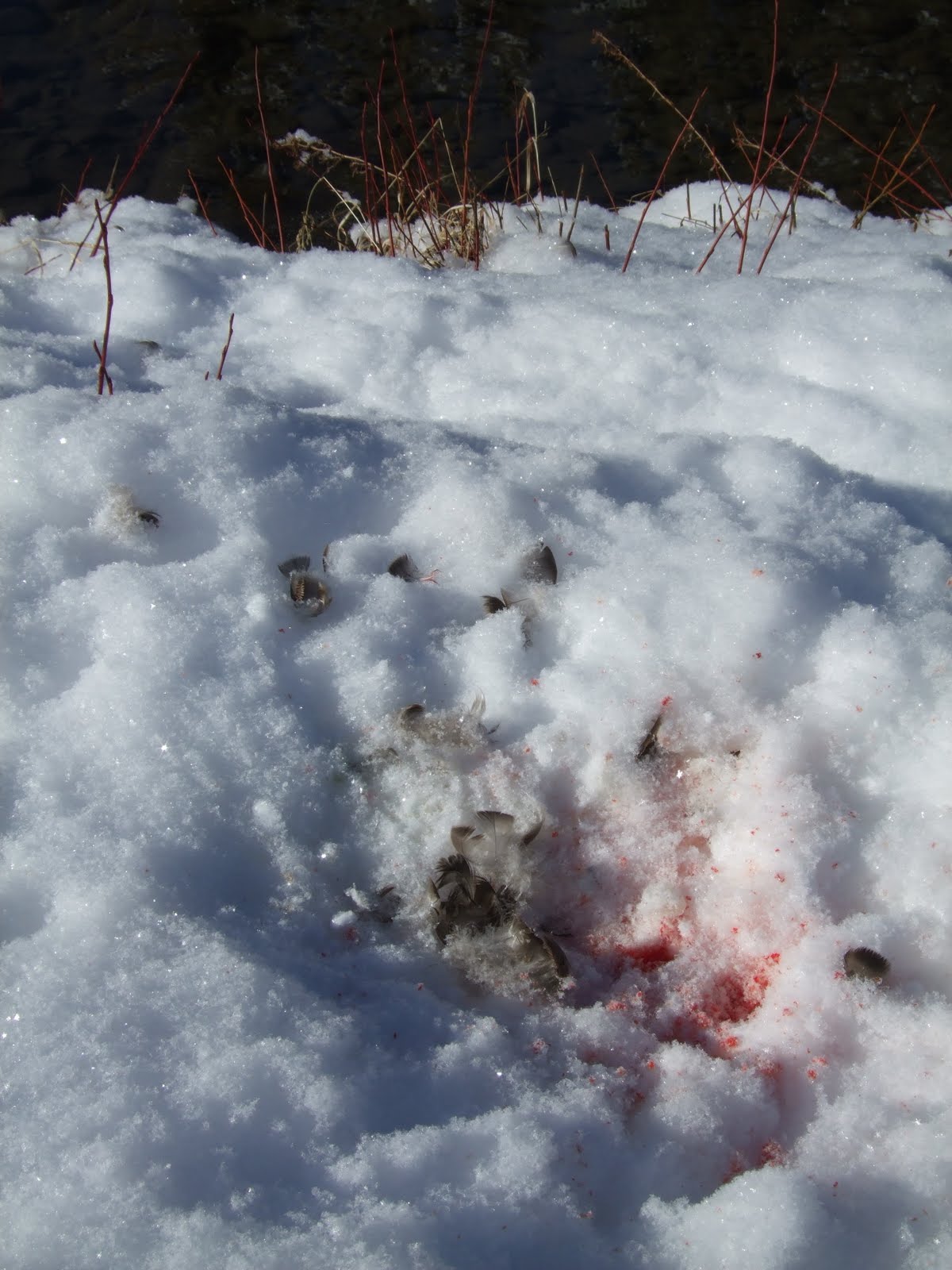
In the fresh snow, there was an area with a bit of blood on the snow, some small downy feathers, and some wing marks in the snow! There were no tracks around the site, other than the trail, and no tunnels either-- it was a mystery! Robin and I discussed for a while what could have happened- at first we thought a large bird had gotten a weasel that had put up a fight, but without tracks or a tunnel, it couldn't be!
Here's a more close up shot of the scene:


We decided it must have been a large bird killing a small bird. A male golden eagle has been visiting our female all winter-- perhaps this was his meal?
That same morning, there were also beds on the path where a couple of elk had been spending the night.
I'll admit, I was wrong-- there are still lots of things to learn about Hallam Lake!