Thursday, October 18, 2012

Join us for ACES' Annual Harvest party at Rock Bottom Ranch

This Saturday Rock Bottom Ranch hosts a harvest festival like no other! Enjoy pumpkin carving, face-painting, ranch games and pony rides. Party-goers can learn how to press their own apple cider and visit with our beloved farm animals! But this party isn't just for the little ones: a delicious lunch by Crystal River Meats and Whole Foods will complement beer and wine sponsored by Four Dogs Fine Wine and Spirits, and hard cider generously donated by Blossomwood Cidery. Perhaps the most exciting addition to this year's party will be live music by Grammy-nominated band Missed the Boat, who are traveling from Steamboat Springs to entertain our Harvest Party crowd!

So please join us Saturday, October 20th, from 12 - 4pm. This is a car free event. Ticket and shuttle information below. See you at the Ranch!

• Tickets $10/person
• Members’ kids free
• Kids under 2 free
Membership starts at $50/year 

This is a car-free event! 

Please ride your bike, walk, or horseback ride down to RBR.
- OR - 

Park at one of our FREE SHUTTLE LOCATIONS to hitch a ride to the Ranch:

-El Jebel 'Park and Ride (on El Jebel Rd behind the Wendy's)

-Basalt Middle School

Questions? Please call RBR at 970-927-6760

Friday, October 12, 2012

Backpacking with Kids: A Whole New Adventure


“Mami, are we there yet?”

Right. If you’re a parent you know exactly what that means. And no, we are NOT on a road trip. “Mami, really, we must be there soon, right?” Luka, my 4-year old son echoes the earlier statement from Zala, my 6-year old daughter. We are about two and a half hours into our backpacking trip. It’s been raining on and off, luckily just a drizzle for now, though ominous looking clouds lurk too close for comfort.  It’s the last weekend before school starts and we haven’t backpacked yet this summer. So, sunny or not, we’re going for it.
Summertime in the Rockies is simply magical, and we love all things outdoors – be it car camping, short exploratory hikes, biking, floating down the river, or backpacking. The latter takes a bit more preparation and a LOT more patience. Backpacking with kids is a whole new adventure no matter the level of experience in your previous life (remember, that life before kids?). We attempted our first backpacking trip as soon as our kids were big enough to walk with a backpack for about half an hour. Knowing our limitations of low mileage and low carrying capacity made this a fun challenge. But little people mean little impact, so off the trail we went and found wilderness experiences about half a mile away from the car, perfect. Filtering water, finding firewood, looking at stars and waking up to greenness around us was magical. The kids were hooked! Or so I chose to see it...
“MA-MIIII!!” Right, time for a snack. Time for yet another break, just short enough to put something in their mouths as I frantically try to change the flow of energy from exhausted to excited: “Wow, look at these ants carrying a big leaf" and, "oh, this flower has such an interesting pattern. Do you think you can count the petals? Oh, see how the shadows make this tree look so giant? Wow, this rock looks like an egg…” Constant mouth diarrhea as I try to distract, change focus, pack up and get going before they realize they’re walking again. We make up funny stories, rattle off nature facts, do math, talk, listen, be quiet and just keep walking. Then somehow, like a miracle, there we are. Just at the right time. We find an awesome spot, this time in real wilderness, quite a few miles away from the sounds, lights, and busy-ness of everyday life. Kids get it; they play, explore, and run around as if the last four hours didn’t happen. Crazy.
The tent goes up and soon we’re cozy and exhausted in our sleeping bags. “Mami, can we hike some more tomorrow?” My heart sings as I hear that. But as Zala and Luka drift off in their sleep I can’t help but think that the reality of hiking tomorrow will again be the schizophrenic pattern of happiness and overload, just like today. Walk and bask in the excitement of Zala’s voice as she watches the little butterfly land on a flower just so. Walk and listen to Luka’s whiny voice telling you how he REALLY can’t go any further. Walk, laugh, distract, try to be patient as they ask “Are we there yet?” for the fiftieth time. Walk and keep walking. Because magic happens at every step and I wouldn't have it any other way.

Wednesday, October 10, 2012

Being Bear Aware


One of the most enjoyable aspects of living in Aspen is the ease of access to nature.  The close proximity also gives many animals easy access to the city. As Aspen dwellers, we must live responsibly in this place in order to facilitate safe urban/wildlife interactions.


In September, bear activity goes into hyperdrive.  Bears will begin hibernating in late October/early November, so now is their final push to gain as much weight as possible. This time of year, bears feed for up to 20 hours per day, hoping to consume at least 20,000 calories before heading into a hibernation that may last 7 months.  In fall, bear encounters in town are not uncommon, especially after a dry winter and summer that yielded low crops of berries and other natural food sources. Bears will eat almost anything, which is why we must be so careful.

How can Aspenites be more bear friendly? I'm glad you asked:
  • Obviously, do not feed bears!
  • Safely dispose of trash in bear proof trashcans. If unavailable, do not move trash out for pickup until immediately before garbage truck arrives (Since June 1, 2010 the city of Aspen has required residents to utilize bear-resistant containers for "day of" pick-up.)
  • Store pet food indoors
  • Do not use bird feeders from March to November. Or, hang bird feeders in a bear-inaccessible location like off of a strategically hung wire, instead of from a tree (easy pickings for a black bear)
  • Do not leave food in your car and be sure to lock your car doors
  • Keep your dog on a leash
  • When camping, store food properly in bear canisters or bags far from campsite
  • Do not leave marinated steak on your porch for weeks on end...
Bears are wild animals, but they will make use of any food source they can find.  When bears find an easy food source in town, they quickly become habituated, thus endangering themselves and potentially the community.  Bears associating food with humans, trashcans or towns causes the overwhelming majority of conflicts. Please do your part to help!

To learn more about how to live "Bear Aware" visit these two helpful sites:
http://www.aspenpitkin.com/Departments/Police/Aspen-Bears/
http://wildlife.state.co.us/WildlifeSpecies/LivingWithWildlife/Mammals/Pages/LivingWithBearsL1.aspx


Thursday, October 4, 2012

Smuggler Mountain Restoration Work


ACES' For the Forest Program is excited about upcoming collaborations with local and federal government agencies to promote healthy,
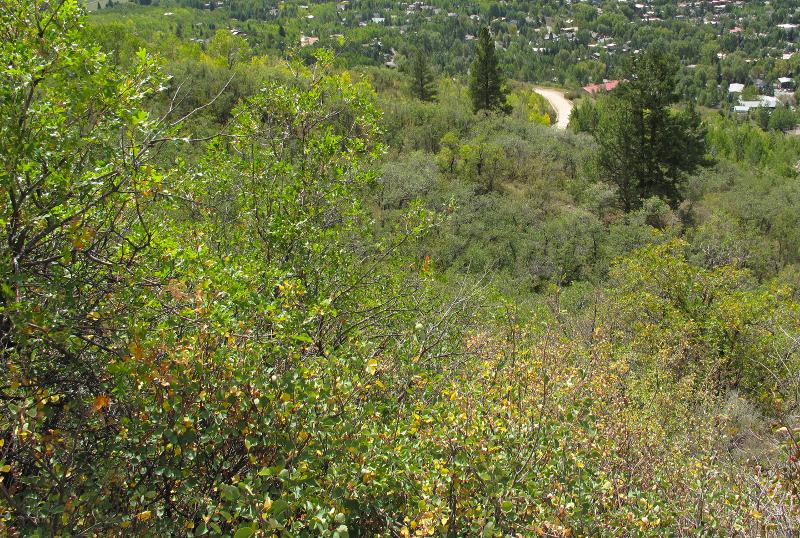
Gamble Oak on Smuggler Mtn
Overgrown gamble oak on Smuggler Mountain
resilient forests.

Beginning today ACES, the City of Aspen, and Pitkin County Open Space are working together on three restoration projects in the wildland-urban interface on Smuggler Mountain. Each project seeks to improve wildlife habitat, and reduce fuel loads in different vegetation types: Gambel oak, lodgepole pine, and aspen. These projects will be visible from popular hiking and biking routes on Smuggler.

In the absence of periodic, natural disturbances such as fire, vegetation in this area has become old and overgrown, leading to increased fuel accumulation and lower quality forage for wildlife. The restoration projects taking place next week seek to mimic natural disturbance events by mechanically opening up the understory and stimulating new growth.

If you're hiking or biking on Smuggler in the next few weeks, keep an eye out for ACES' interpretive signage detailing the ecological benefits of each of these projects. The signs will be located at the site of each project, so you will be able to track progress.

Further questions about ACES' collaboration with the City of Aspen and Pitkin County on these restoration projects can be directed to Jamie Cundiff, ACES' Forest Health Programs Director, at jcundiff@aspennature.org.

Monday, October 1, 2012

A Sapsucker's Busy Work

When scanning a cluster of river-side serviceberry bushes through my binoculars on a recent birding excursion, a light honeycomb-shaped mosaic caught my eye. After closer inspection (and a hint from ACES' Naturalist Rebecca Weiss) we decided the grid was the result of a busy red-naped sapsucker. The serviceberry trunks in front of us were home to multiple generations of sap-wells; some barely visible scars of wells from seasons past, and others brand-new, still oozing sap and darkening the bark around them.  Rebecca began to explain the fascinating details about these sap-wells. To begin with, they are feeding hot-spots; not only for the red-naped sapsucker, but also for an array of other species that come to rely on the bird's work. There were two kinds of wells littering the surface of this particular serviceberry stand; some were the diameter of a quarter and are holes that the sap-sucker must continually maintain to keep sap flowing. The others holes and bark scars showed punctures, akin to a Parcheesi board and no wider than a pen, where the sap suckers uses its bill to probe the tree looking for sap.


The gallery of holes, regardless of size, were all carved in the soft bark of the tree by a bird no bigger than my hand. The red-naped sapsucker, Sphyrapicus nuchalis, is a medium sized-woodpecker. These industrious creatures are denizens of lower elevations of the Rocky Mountains.  Both male and female boast red feathered throats; perhaps their most identifiable characteristic. However the red-nape that their name suggests refers to a tiny patch of red at the back of the head/neck. The red-naped sapsucker seek out nooks in soft-barked trees like willow, aspen, poplar and fruit trees where decay has softened generous spaces. Sap suckers develop real estate in their chosen trees over the years: beginning by building out hollows close to the ground and subsequently building spaces higher and higher in the tree. Like all sapsuckers, they eat insects, fruit and sap which flows within trees' cambium layer, the living tissue just beneath the outer protective bark. Insects and other sap-feeding bird life come to rely on sapsucker feeding holes. One might call this crucial behavior characteristic of a keystone species, which by definition, is an organism in the ecosystem that many other species depend upon for continued survival and support. However the opportunistic sapsuckers will also eat the insects attracted to their wells, doing so by the dramatic fly-catching technique made possible by their small tongues. The sap sucker will use its beak and tongue to poke, pry and tap bark for insects, and it's tongue to fly-catch and sip or lick sap.

Next time you hear a slow, irregular tapping in the lowland forests of the Rocky Mountains, keep your eyes peeled for these beautiful creatures and the feeding hot-spots they create.

Sources:
    •    Rebecca Weiss
    •    http://www.websters-online-dictionary.org/definitions/Keystone+species
    •    http://en.wikipedia.org/wiki/Red-naped_Sapsucker
    •    http://www.allaboutbirds.org/guide/Red-naped_Sapsucker/id 

Thursday, September 20, 2012

View looking North from the peak of Mt. Elbert, taken June 23, 2012
Mt. Elbert Thoughts

The rocky alpine zone witnessed on the approach to Mt. Elbert is speckled with
blue and purple Phlox flowers. They offer a stark contrast to the Earth tone rocks
which cover the landscape. The individual rocks if viewed closer are much like the
larger landscape of which they are a part of. They too are accented with colorful
minerals and crystals that sparkle in the sunlight which give the rocks a more vibrant
character. Standing atop the Rocky's tallest peak is like standing on the bow of a
great ship, looking out over a stormy sea frozen in time.

Taking deep breaths of cool crisp mountain top air quenches the primal thirst for high country exploration.

Friday, September 14, 2012

Outlook over Tivoli Bay, Hudson River, and Catskill Mtns


Choose Your Own Adventure

What's more important in life than surrounding yourself by beautiful people? The answer is nothing, however a close second goes to beautiful places. The conclusion of this summer was a difficult period for me. Leaving not only an amazing group of individuals at ACES but the natural beauty in which Aspen is nested, to move East to New York was challenging and forced me to reconcile my inner conflicts caused by this life decision. 

As someone who has felt a deep connection with high and wild places since the first time my boots gripped the side of a mountain, I was unsure if my new home could satiate my hunger for exploration. I soon discovered that it in fact could and to a degree I never thought imaginable. 

The forests are vast and dense, the rivers are plentiful and come in all varieties, and the landscape teems with life. The land may not rise and fall quite as dramatically as it did in Aspen, but the moderate terrain hides many secrets. It was only a couple months ago that Blue Columbine captivated me as I strolled along Colorado trails. Now it is the 400 year old White Oak trees, climbing vines, and Red Efts which draw my attention. Beauty through pure diversity.

That is one of the most magnificent qualities of this country. The ability to travel from one incredible place to the next without even having to go through a customs officer making you feel guilty for something you have never done. No matter where you go in life and what preconceived notions you carry along the way, always seek adventure. Look for the amazing things happening around you, big and small. Be inspired and take a moment to appreciate the uniqueness of a place.

I often wish I was still in the West, but I have found another horizon here in the East and it is a horizon largely unexplored by my mind, body, and spirit until now. The Aspen idea applies no matter where you find yourself. The adventure always awaits.


Unnamed ridge in the Maroon Snowmass Wilderness

Don't Leaf Aspen Without Peeping Those Colors!


Leaf Peeper: (n.) One who travels to view and photograph changing leaf colors in the fall.
Examples: off-season fall tourists populating the Maroon Bells; that relative that refuses to come visit you in Aspen unless it is the third week in September.

The Catto Center at Toklat, a site of ACES, is located up Castle Creek, a prime leaf-peeping location.
Join us there for our annual membership potluck and fall colors celebration on Thursday September 20th at 5pm. RSVP here.

Ever since Labor Day passed, the influx of summer-season tourists has slowed—we have officially entered the off-season.  Streets are calm, darkness comes a little earlier in the evening, and the grocery stores are navigable after five o’clock.  However, the Roaring Fork Valley's fall foliage produces an ephemeral golden light-show that brings one last burst of visitors before the winter. 

When asked about timing a visit to Aspen to see the changing leaves, locals consistently point to the third week in September as the height of the color.  It’s this time when the mountainsides are blanketed with the vibrant yellow of Aspen leaves, intermittently mixed with the dark green of the conifers.  But exactly why do the Aspen leaves (and other leaves, too!) change color in the fall?

Most people are familiar with the fact that leaves contain chlorophyll—that’s the component that gives them their green pigment and allows for the process of photosynthesis.  Chloroplasts are the little green engines of plant cells which capture sunlight to synthesize carbohydrates and sustain plant life. These chloroplasts contain the green chlorophyll which breaks down easily, and yellow carotenoids which are more durable. As nights lengthen and plant metabolism slows, the chlorophyll breaks down and allows the yellow carotenoids to shine through. With slower metabolism, leaf veins begin to clog and red anthocyanin sugars concentrate in the leaves, shining through like the carotenoids. Leaves high in carotenoids are yellow, those with a blend of carotenoids and anthocyanins are orange, and those high in anthocyanins are red. 

So, grab your cameras… now is the time!  Luckily for all the leaf peepers out there, I recently learned that the United States Forest Service maintains a Fall Colors Hotline, complete with updates on peaking colors in different National Forests around the country and suggestions for color-seeking activities.  Feel free to embrace your inner leaf-peep and give it a call at 800-354-4595. Or give ACES a call for suggestions on local foliage hot-spots in the Roaring Fork Valley!

Tuesday, September 11, 2012

Meet ACES 2012-2013 Educators

Clockwise, beginning bottom right: Myles Somerville, Sarah Onstad, Melanie Poole, Sarah Schmidt, Andrew Hays, Betsy DeFries, Kendall Reiley, Erin Cushner, Chris Cohen.
Not pictured: Erin Griffin, Betsy McMichael.

For over 35 years ACES has partnered with schools in the Roaring Fork Valley to bring environmental science education to pre-school through high school students. ACES provides 350 field programs and 2,067 classroom lessons throughout the school year. 

This week you will see ACES Educators teaching geology to 5th-graders at the Maroon Bells, teaching tree identification to 6th graders at Hallam Lake, teaching kindergarten through 4th grade Environmental Science Education classes at Aspen, Basalt, or Crystal River Elementary Schools, and teaching preschoolers about the farmyard at Rock Bottom Ranch!

ACES is fortunate to have amazing educators to lead our programs. Learn more about our current staff here. Interested in applying next year? See our job description here. For parents in the Roaring Fork Valley, come visit us at Back to School Night on Wednesday at Aspen Elementary School and on Thursday at Basalt Elementary School.

Thursday, August 30, 2012

Getting to Work


I registered for Pandora (internet radio) in the Bay Area, where I grew up.  Every so often, they’ll play a commercial for California’s ‘Spare the Air’ program, which encourages residents to leave their car at home and take alternative transportation when the local Air Quality Index reaches unhealthy levels.  This index was developed by the EPA and establishes a minimum threshold for when ground level ozone pollution, commonly known as smog, reaches unhealthy levels.  Their commercials pose a series of alternative commuting scenarios (carpooling, public transportation), asking ‘What is the favorite part of YOUR commute?‘

Those commercials and that world seem like a whole other lifetime ago.  These days, the favorite part of my commute is waking with the sun and taking an 11-mile ride to work that many consider one of the best in Colorado.  On the weekdays, it’s complete solitude as the blood sings in your ears and your muscles work in concert to bring you, your bike and your belongings from 8,000 feet to just over 9,500.  On the weekends, the camaraderie of shared experience makes for a euphoric bonhomie among riders.  I’ve come to enjoy each in their turn.  As our time here in Aspen comes to an end, I’m coming to realize that the days of meeting horses or passing waterfalls on my morning commute are also coming to a close.  Whatever my next commute has in store for me, whether car, bike or public transportation, I know that I’ll find the silver lining eventually.  It just may take a little longer than it did here in Aspen.
Rounding the bend on Maroon Creek Road

Owl Creek Trail and a curious onlooker

Rio Grande Trail, on the way back to ACES from Snowmass Village